
Terminus Est
And why it matters that it is a big, badass sword.

Having recently completed Gene Wolfe’s masterful The Book of the New Sun, I have been struck by the fact that a crucial feature of the work is, to my eye, somewhat undertheorized. Contemporary discussions of Wolfe’s work often praise its complexity, its allusiveness, its thematic richness, and the way it often both requires and rewards multiple readings in order to properly appreciate. When eulogizing Wolfe (who died in 2019), writers will describe The Book of the New Sun as “a story that fuses science fiction with pulp fantasy, then fuses both with modernist narrative technique, Catholic theology, and Proustian meditativeness,” or a “curse,” a “problem,” a “puzzle that can’t quite be solved.” They will call it the “Ulysses of fantasy novels.” There is nothing wrong, and quite a bit right, with all of these descriptions and tendencies. Certainly when I talk about Wolfe I tend to highlight his complexity, the glory of his language, and his maddeningly beautiful refusal to ever take it easy on any of his characters or his readers. Yet these pictures, however correct, are incomplete. The Book of the New Sun is, yes, a “surreal bildungsroman,” written by a “difficult genius” who is “our Melville.” It is also, crucially, and possibly equally importantly, rad as hell.
The main character of The Book of the New Sun is Severian, an apprentice in the guild of torturers (or, more precisely, the Order of the Seekers of Truth and Penitence) who, after impermissibly showing mercy to one of his unfortunate “clients,” is exiled from the guild and embarks on a trippy and meandering journey that ultimately sees him take the throne and possibly save all of humanity from a slow but inevitable apocalypse. For much of the novel, he carries a beautiful, huge greatsword, Terminus Est, that serves simultaneously as the badge of his office (it is an executioner’s blade), a walking stick, a method of self-defense, and an object of fascination to both him and those he meets, for good or ill. As Severian serves as a Christlike figure throughout the narrative, one can make a lot of hay out of the fact that him carrying this symbol of capital punishment all over the world is not unlike Christ carrying his cross along the Via Dolorosa. Much can be said about the way the phrase “Terminus Est” is translated in the novel (as “this is the line of division”) and how that differs from a more straightforward translation of the Latin phrase (“this is the end” being the most obvious translation.) Let me be clear: this is very important; it is absolutely an essential part of the text and of one’s comprehension thereof. But it is also important that Terminus Est is a kick-ass sword. It is essential to a proper appreciation of the novel to remember that Terminus Est is a dope name for a sword, and that the sword would do well on the cover of a metal album.
There are too many examples of radness in The Book of the New Sun to list, but let me list a few anyway. The guild of torturers resides in a citadel that is actually a derelict spaceship! Severian gets into a fight with a giant wielding an enormous mace who flies around with a sci-fi belt that gives him antigravity powers! We meet one major character while he is robbing a grave dressed in full aristocratic attire, carrying both a laser gun and a sword cane! And, perhaps most on point: Severian is once rescued by “anpiels,” beings whom he describes as “fair to look upon, naked and having the slender bodies of young women; but their rainbow wings spread wider than any teratornis's, and each anpiel held a pistol in either hand.” Let us be honest, one with another, as befits men and women of culture and taste: that is the sickest thing in the world. There are very few images in The Book of the New Sun that would look out of place if airbrushed on the side of a van.
So why does this matter?
One school of thought might say that a writer like Gene Wolfe takes sci-fi/fantasy concepts and elevates them; that he works with the rough, ridiculous matter of the pulps and turns them into something worth paying attention to. He transforms the puerile art of the scribbling hacks into something transcendent; he sees the rare, accidental moments of beauty found within the wasteland of genre fiction and builds a new church on their desolate bones.
In this reading, an artist working in genre fiction like Gene Wolfe functions as a sort of Trojan Horse, hiding real artistic quality behind a veneer of pulpy science fiction. In this way, Gene Wolfe forces us poor, benighted sci-fi fans to think about Proust and Joyce by luring us in with dope swords; it is not as good as the real thing, but it’s better than nothing. To this school of thought, Wolfe is essentially a concession to the depraved palates of the sci-fi classes, a lesser shadow of the Platonic Form of Real Genius.
But I think this is wrong. Gene Wolfe is not a way to trick you into eating your vegetables. The Book of the New Sun is not a gorgeous piece of art in spite of its radness, in spite of its dope-ass greatswords and naked rainbow-winged pistol chicks; it is beautiful because it features those things while also asking all the great questions of human existence in the highest possible register. A version of The Book of the New Sun that was not rad as fuck would not only fail to capture the attention of the average sci-fi reader, it would also be a significantly lesser piece of art.
To be clear, I am not saying that the appropriate way to read Gene Wolfe is to ignore the high-concept philosophizing and focus only on the cool swords. No reasonable person could possibly think that would be the right way to read Wolfe, though I am enjoying imagining a type of guy who rolls his eyes at a discussion of, say, the influence of Borges on The Book of the New Sun and instead says we should just turn our brains off and enjoy the ride. What I am saying is that, contra the famous meme, to properly appreciate Gundam one must perceive not just “war is bad,” but also the equally important concept of “wow!! cool robot!!!”
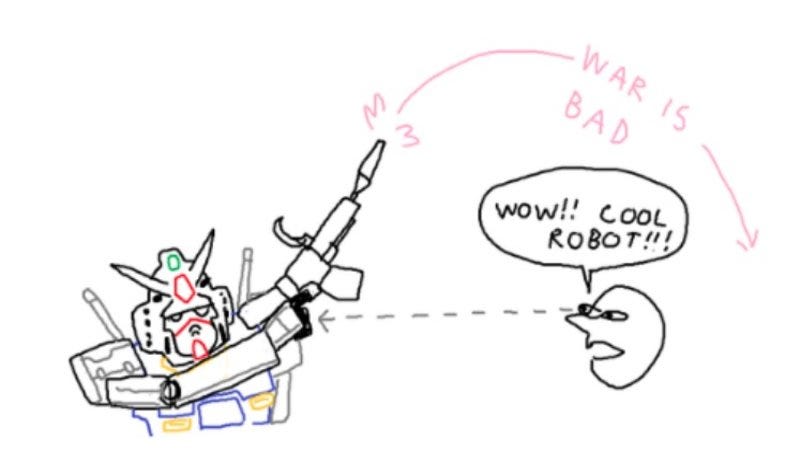
Or, to put it yet another way, I am saying that Gene Wolfe does not transcend sci-fi concepts and tropes, in the sense that he is rising above them or leaving them behind; he does not hijack them for a higher purpose for which they were not originally intended. He is instead performing genre tropes at the highest level. If he’s better than most of the other genre writers, and he is, it’s because of the way he marries the trappings of a rollicking sword-and-sorcery adventure to the conventions of someone like Proust. Like any good marriage, these two halves serve to make each other better.
The Book of the New Sun is beautiful in an operatic and grandiose fashion, and all of these rad things are a major part of why. They serve to heighten the stakes of Severian’s introspection and philosophizing. When he stops to wonder at the beauty of the constellations or to think about the nature of Time, it is his rad context that makes this legible instead of simply ridiculous. Here is a man who lives beneath a dying sun, who meets two-headed giants and memory-devouring monsters and enormous ambulatory statues; of course when he’s alone he wonders about the purpose of life!
And maybe I don’t know what the hell I’m talking about; I haven’t actually read Proust, after all. Maybe some day I will, and I’ll forsake the vale of tears that is genre fiction and will take my rightful place amongst the heavenly appreciators of Real Art. But I doubt it. In the meantime, I will continue to both contemplate the symbolism of Terminus Est’s “male” and “female” edges; and hang a giant poster of it in my dorm room over my bong.
And this is why I don’t really buy that “SF is respectable now”, because all the “respectable” SF is just Real Art cynically employing SF elements while taking no actual interest or joy in them. Wolfe is incontrovertible proof you can do both.
Not gonna lie his descriptions do not read well. The quotes you included seem like the same unimaginative blase sci Fi as always. Tetroni and severins don't discount the stupidity of the description of a rainbow angel with guns. This seems like comic book writing for acid rotted 15 year olds.